Facial analysis
Before and after, side by side
Two photographs, side by side.
- What it does
- The first click selects the shot under review; the second adds the comparison: same face, two dates, side by side at the same size.
- What it doesn’t do
- It doesn’t align, retouch, or overlay the two images. Straightening a different pose would make the change appear more dramatic than it is.
- Who controls
- You choose the two photographs and change them anytime.
When two shots can’t be compared.
- What it does
- If the pose differs (chin raised, head rotated), the page notes this above the photograph before anyone interprets framing as a result.
- What it doesn’t do
- It doesn’t block anything or discard the shot. Hiding a photograph would suggest a malfunction rather than a pose to retake.
- Who controls
- You decide whether to retake the shot or view it as is.
The assessment, with the shots it refers to.
- What it does
- From the comparison, record the Global Aesthetic Improvement Scale (PGAIS): the label remains linked to the two photographs you were viewing and their dates.
- What it doesn’t do
- It doesn’t calculate or suggest it. The response is a label, never a number: that scale is numbered in opposite directions in the literature, and a number without its direction can’t be interpreted years later.
- Who controls
- You write it, and it’s the only thing this page saves to the medical record.
The face’s shape in three dimensions.
- What it does
- From the same photograph, it reconstructs the face’s shape and rotates it: surface, mesh, or color-coded depth map, which is how a volume asymmetry becomes visible to the eye.
- What it doesn’t do
- It’s not a scan: depth is estimated from a single photograph and is relative. Protrusions or volumes aren’t measured, and the page states this below the model.
- Who controls
- It’s for viewing and showing. What remains in the medical record is the photograph.
What’s not included
There’s no score, and no measurements.
Neoclassical canons don’t describe real proportions outside a limited population, and a score would give an air of objectivity to a concept of beauty that changes by country and decade.
And there are no numbers: no angles, no facial third ratios, no millimetres. A clinical number is worth exactly as much as the accuracy declared alongside it and the person who answers for that accuracy: without those two things it is an uncalibrated ruler that looks calibrated. We took them out, and that is a choice, not an omission.
The only comparison that doesn’t assume an ideal is the face with itself over time, and that’s what you’ll find here.
For the same reason, there’s no outcome simulation: showing an ‘after’ that hasn’t happened yet is a promise, and you’re the one who has to keep it.
The shot
Two photos can be compared if they are taken the same way.
The photographic protocol is a series of defined views (frontal, lateral, 45° oblique, plus dynamic shots for facial expressions) repeated identically at each visit. Each photograph corresponds to a view, and the record shows which ones are missing.
When taking a shot from the camera with a selected view, the previous shot of the same view appears transparently in the viewfinder: overlaying the face on the ghost image is the practical way to match framing and distance.
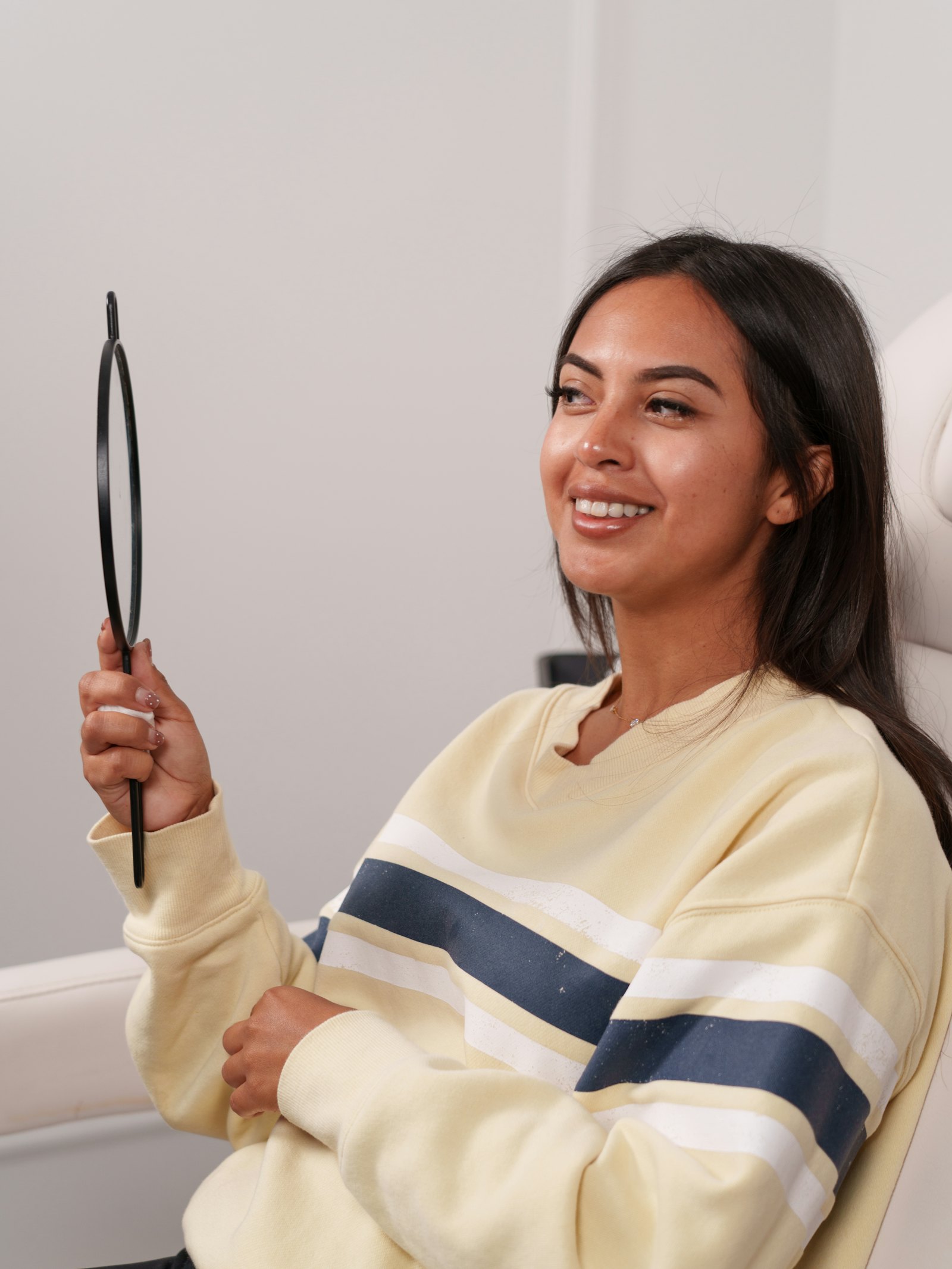
There’s also the live mirror: the camera shows the patient their face while you discuss an area. It doesn’t measure or record anything and stays off until you turn it on.
The list of views informs but doesn’t block: an out-of-series shot remains allowed.
Where it fits in the product
Included in all plans
It’s not a separate module or an add-on: anyone who opens a medical record gets facial analysis from day one, even on the smallest plan.